

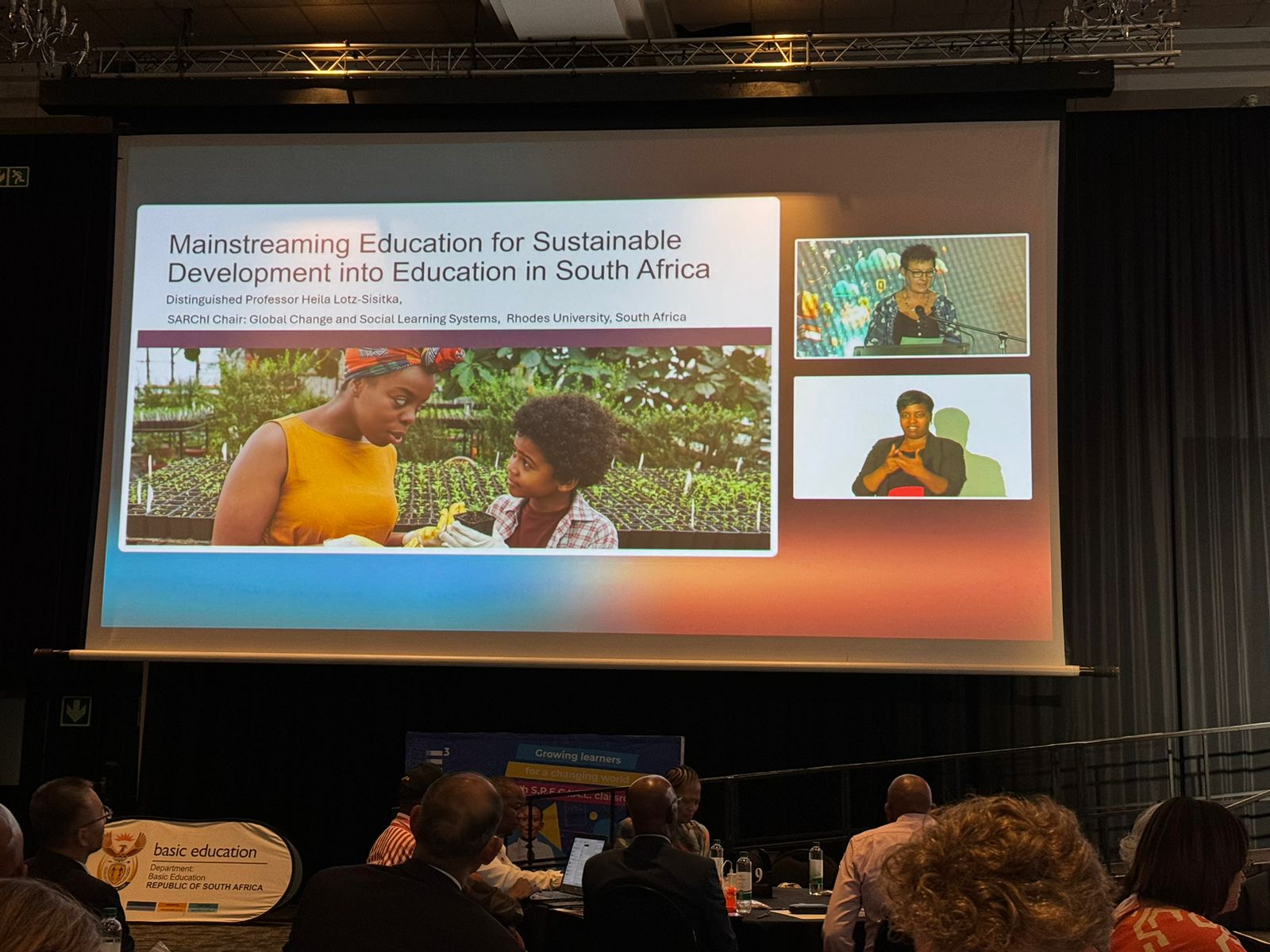
 At the 2024 DBE Lekgotla, Distinguished Professor Heila Lotz‑Sisitka called for the urgent mainstreaming of Education for Sustainable Development (ESD) across South Africa’s basic education system. Her message was clear: after three decades of curriculum reform, South Africa must now move decisively to embed sustainability thinking into the heart of teaching, learning, and educational leadership. Her argument is backed by scientific evidence, national policy priorities, and the lived experience of a country facing accelerating climate and ecological instability. [
Drawing on national climate data, Professor Lotz‑Sisitka highlighted South Africa’s rising temperatures, intensifying heatwaves, growing water insecurity, and increased climate‑driven shocks—all of which underscore the need for a system-wide shift in education. She reminded delegates that mainstreaming ESD is not an “add‑on,” but an essential component of quality, future‑oriented education in a rapidly changing world. Sisitka said that the youth wanted system change, not climate change, and it remains important to mainstream ESD into the curriculum in order to facilitate change.
Her presentation emphasised that ESD equips learners with the knowledge, competencies, and values needed to navigate a world defined by environmental risk, social inequality, and the demands of a just transition. Central to her message was the idea that every learner, teacher, and official must understand the human–environment relationship, develop agency for change, and act toward sustainable futures. This aligns with Professor Lotz‑Sisitka’s internationally recognised research focus on transformative social learning and green skills development, areas in which she has led numerous national and global initiatives.
She outlined a practical 10‑point approach for a system-wide transition—ranging from empathy and care, visionary leadership, and intersectoral collaboration, to maximising existing programmes, building teacher capacity, sharing knowledge resources, and strengthening monitoring and evaluation. These mechanisms, she argued, are essential to shifting South Africa from fragmented sustainability efforts to a cohesive national strategy aligned with both continental and global priorities.
Lotz‑Sisitka reminded the Lekgotla that sustainability thinking is not new to Africa. She encouraged the adoption of relational, circular and interconnected approaches, rooted in longstanding African knowledge traditions. As South Africa prepares for curriculum revisions, she called for stronger integration of cross‑cutting themes such as climate action, healthy environments, water security, biodiversity, circular economies, and sustainable food systems
In closing, she stressed that “this earth is our home, and we must all act now.” The mainstreaming of ESD, she argued, is central not only to educational transformation but to ensuring the well‑being of present and future generations. This call for system-wide ESD mainstreaming directly reinforces the aims and achievements of the Fundisa for Change programme a national teacher professional development initiative that Heila has co‑led for over a decade.